


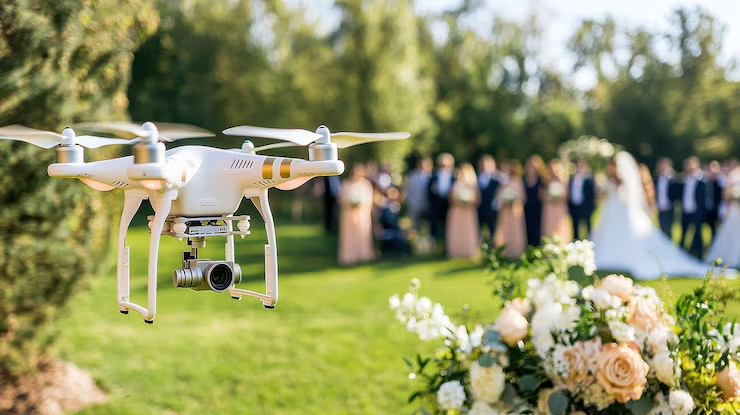
An aerial photo of a ceremony changes what the day looks like in your album. From the ground, your wedding was a hundred people in chairs. From 180 feet, it’s a hundred people arranged in a clearing surrounded by forty acres of October color in Wyoming County.
That’s the case for drones. There’s also a case against them, and a set of rules most couples have never heard of that decide whether the shot is even legal at your venue.
This covers both, plus what to actually ask before you pay for it.
What Aerial Coverage Adds That Nothing Else Can
Ground photography documents faces. Aerial photography documents place.
Western New York has the terrain for it. Gorges at Letchworth. Vineyard rows along Keuka and Canandaigua. Lake Erie shoreline south of Buffalo. Farmland outside Batavia that runs flat to the horizon. Snow-covered fields in a February elopement. None of that reads properly from eye level.
The Three Shots That Justify the Cost
Most drone coverage at a wedding produces a small number of images that matter. Here they are.
The ceremony from directly overhead. Guests in rows, aisle running through the center, couple at the front, the whole geometry visible at once. This is the single most requested aerial frame and the one couples print. It works because it shows scale and arrangement, which no ground camera can do.
The couple alone in wide terrain. Two small figures in a field, on a dock, at a treeline. The subject becomes tiny and the setting becomes the point. Emotionally different from a portrait, and it belongs in the album as a counterweight.
The venue in context. The barn with its surrounding property. The lakefront with the water beyond. This is the frame that answers “where were you” better than any establishing shot from the driveway.
Everything beyond those three tends to be repetitive. A photographer selling you forty aerial images is padding.
The Legal Part Couples Skip
This is where drone coverage goes wrong, and it goes wrong at the venue, on the day, with no fix available.
The Pilot Must Be Licensed
Any drone flight for compensation in the United States requires an FAA Part 107 Remote Pilot Certificate. A wedding photographer flying a drone as part of a paid package is operating commercially. There is no hobbyist exception for this.
Ask to see the certificate. Not a claim. The document. Photographers who hold it will send a photo of it without hesitation, because they went through a written exam to get it.
An unlicensed operator exposes you to a stopped flight, a venue conflict, or a photographer more focused on not getting caught than on the images.
Airspace Restrictions Are Real Around Buffalo and Rochester
Both cities have controlled airspace surrounding their airports, and it extends farther than people assume.
| Airspace Class | Where It Applies | What’s Required |
| Class B / C surface area | Immediately around Buffalo Niagara and Greater Rochester airports | Prior authorization, often instant via the LAANC system, sometimes denied |
| Class D | Around smaller towered fields | Authorization required, usually granted with altitude caps |
| Class E surface | Extends outward from some airports | Authorization required |
| Class G | Most rural WNY venues | No authorization needed, standard rules apply |
| Restricted or special use | Near certain government or military facilities | Often no flight at all |
A ceremony at a venue two miles from Rochester’s airport may be capped at 50 feet, which limits the overhead shot considerably. A ceremony in Naples or Castile is usually unrestricted.
A licensed pilot checks this weeks ahead, not on the morning of. Ask when they’ll confirm your site’s airspace status.
State Parks Are Mostly Off Limits
This surprises people every year. New York State Parks generally prohibit drone launch and landing on park property without a permit, and permits for wedding photography are not routinely granted.
That means Letchworth, Chestnut Ridge, Hamlin Beach, and similar sites are difficult or impossible for legal aerial coverage. If your ceremony is at a state park, plan on ground coverage and confirm the current policy with the park office directly.
Private venues make their own rules. Many farms and vineyards allow it. Some don’t, usually because of livestock or neighbor complaints. Get the answer in writing from your venue coordinator.
Weather Kills More Drone Shots Than Rules Do
Western New York wind is the practical limiter.
Consumer and prosumer drones handle sustained winds up to roughly 20 to 24 mph, with gusts pushing the limit. Lakeshore ceremonies routinely exceed that. A site on the Erie shoreline in Hamburg or on Ontario in Webster can be calm at ground level and unflyable at 200 feet.
Rain grounds most drones entirely. Light drizzle is a no-fly for anything without weather sealing, and almost nothing in wedding use has it.
Cold matters too. Lithium batteries lose significant capacity below freezing. A winter elopement flight that should give 25 minutes might give 12.
A Realistic Failure Rate
Ask any photographer who offers aerial coverage how often they can’t fly. An honest answer in this region is somewhere between one in four and one in five weddings, driven mostly by wind and rain.
That means the add-on you paid for might not happen. Ask what the refund or credit policy is for a weather cancellation before you sign. It should be in the contract.
The Noise Objection
Drones are loud, and a ceremony is quiet.
A drone at 200 feet is audible but not disruptive. A drone at 60 feet during vows is a lawnmower. Guests notice. Officiants get annoyed. Video audio picks it up.
Good practice looks like this:
- Fly during the processional and recessional, not during vows or readings
- Hold altitude above 150 feet when guests are seated
- Launch and land away from the ceremony area, behind a treeline or building if possible
- Get the overhead shot in one pass, not four
- Use the drone heavily before guests arrive and after the ceremony ends
Photographers who fly constantly through the ceremony are prioritizing content over your day. Set the expectation in advance.
One Sentence on Video
If you want aerial video as well as stills, hire a team where the drone operator is a dedicated person, because one photographer trying to fly, frame stills, and pull video is doing three jobs badly.
What It Costs and How It’s Sold
Pricing varies widely across the region. Here’s how it typically appears.
| Structure | Typical Range | Notes |
| Included in a premium package | No separate line | Common with studios that own the equipment |
| Add-on for a single flight window | $250 to $600 | Usually 20 to 40 minutes of flight time total |
| Full-day aerial coverage | $700 to $1,500 | Requires a second operator, worth it only for large properties |
| Subcontracted licensed pilot | $400 to $900 | The photographer coordinates, a separate person flies |
| Delivered aerial images | 8 to 25 typical | Beyond that, they start repeating |
Note the delivered image count. Aerial coverage is not about volume. If your quote promises 100 drone photos, ask what they’d be of.
Studios offering this as part of full-day Wedding Photographer coverage in the region will usually tell you upfront whether your specific venue is flyable, which saves you paying for something that can’t happen.
When Drone Coverage Isn’t Worth It
Be honest about your venue.
A ceremony in a small backyard in the suburbs produces an aerial image of a backyard, some roofs, and a neighbor’s above-ground pool. Height doesn’t improve it.
Indoor ceremonies obviously get nothing. A church wedding with an outdoor cocktail hour might yield one usable exterior shot.
Ballroom and hotel weddings in downtown Buffalo or Rochester are typically in restricted airspace and surrounded by buildings, which limits both legality and composition.
A Simple Test
Look at your venue on a satellite map. Zoom to the level where the ceremony site fills about a third of the screen. Does what you see look like something you’d hang on a wall?
If yes, book it. If it looks like an ordinary property, spend the money on a second shooter instead.
Season Changes the Aerial Image Completely
Ground photography looks broadly similar across seasons. Aerial photography does not, because from above you’re mostly photographing ground cover.
| Season in WNY | What the Aerial Frame Shows | Practical Notes |
| Late April to May | Bare-to-budding trees, brown fields, gray water | Weakest season for aerial, terrain looks unfinished |
| June to August | Deep uniform green, full canopy, blue water | Strong, but green can read flat and repetitive |
| Late September to mid October | Mixed color across hillsides, peak contrast | The best aerial window in the region by a wide margin |
| Late October to November | Bare branches, muted browns, low sun | Long shadows can be striking, color is gone |
| December to March | Snow cover, high contrast, dark figures on white | Visually powerful, but cold cuts battery life hard |
That October window is why so many Western New York couples with fall dates add aerial coverage. Hillsides in Wyoming and Allegany counties turn over roughly the first two weeks of the month, and a ceremony under that from 200 feet is genuinely different from anything shot at ground level.
If your date falls in early spring, be realistic. The overhead ceremony shot still works because it’s about arrangement, not color. The wide scenic frames will be underwhelming.
Time of Day Matters More From Above
Overhead light at noon flattens terrain. There are no shadows to define shape, so fields, hills, and treelines lose depth.
Low sun does the opposite. Late afternoon aerial images show ridgelines, tree shadows across a field, and texture in a vineyard’s rows. If your photographer has flexibility, the aerial pass should happen within about ninety minutes of sunset rather than during cocktail hour at 3pm.
Safety Rules That Protect Your Guests
A licensed pilot follows these without being asked. Confirm anyway.
- No flight directly over people who aren’t part of the operation, unless the aircraft meets specific FAA category requirements
- Visual line of sight maintained at all times, no flying behind buildings or treelines
- Daylight or civil twilight only, with anti-collision lighting after sunset
- Maximum altitude of 400 feet above ground level
- No flight over moving vehicles on public roads
That first rule shapes the overhead ceremony shot more than any other. Pilots handle it by flying high enough and positioning so that the aircraft is over the aisle or open ground rather than directly above seated guests. It’s a real constraint, and it’s why the overhead frame usually comes from a bit of an angle rather than straight down.
Conclusion
Drone photography earns its place at outdoor Western New York weddings when the setting is genuinely worth showing: farmland, gorges, vineyards, lakefront, or a property large enough that ground cameras can’t contain it.
Before booking, confirm four things. That the pilot holds a Part 107 certificate. That your venue permits drone launch and landing in writing. That the airspace at your site allows useful altitude. And what happens to your money if the wind exceeds 24 mph on the day.
Then set expectations for the ceremony itself: high altitude, brief passes, nothing during vows. Handled that way, you get three or four images that show your wedding at a scale you never saw yourself, and the guests never think about the drone at all.
That’s the whole goal. A different view of a day you already lived from the ground.
